

Even small adjustments to Medicare Advantage Star Ratings can have significant financial implications for health plans. Through the Categorical Adjustment Index (CAI), the Centers for Medicare & Medicaid Services (CMS) accounts for differences in quality measure performance associated with members' Low-Income Subsidy (LIS)/dual-eligible and disability status.
Because LIS enrollment can influence these adjustments, identifying eligible but unenrolled members may have implications beyond prescription drug affordability. Understanding how the CAI works and the role of LIS enrollment can help health plans better evaluate their Star Ratings performance and identify opportunities within their member populations.
What Is the Categorical Adjustment Index?
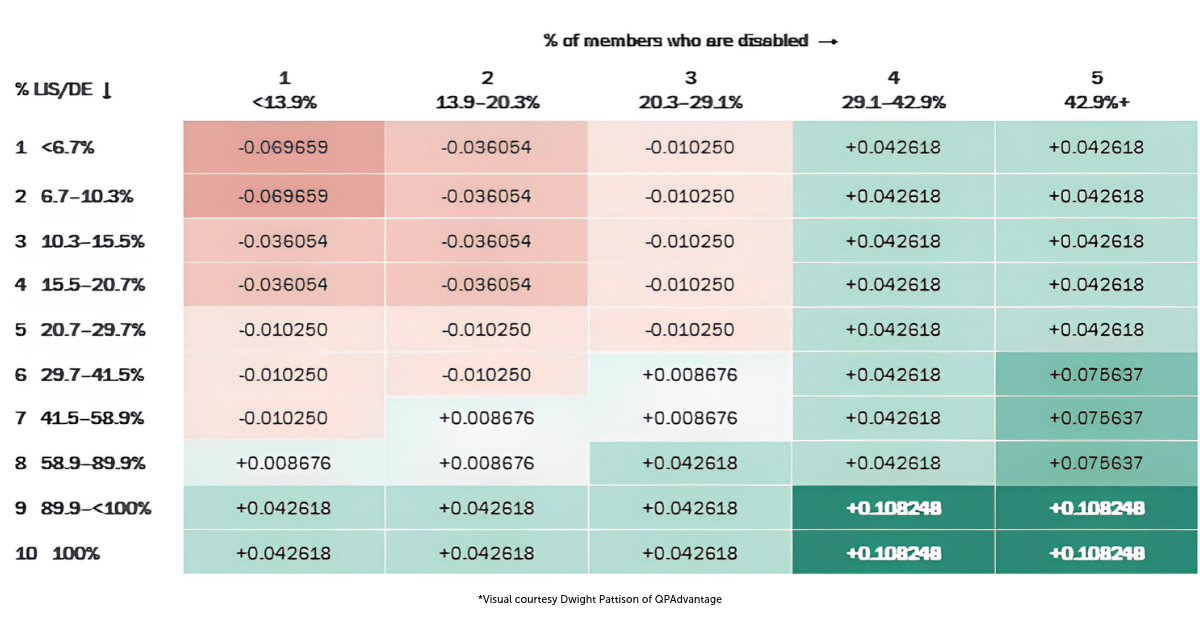
The CAI adjusts Medicare Advantage and Part D Star Ratings to account for differences in quality measure performance associated with two member characteristics:
- LIS and dual-eligible status: Members receiving LIS and/or fully or partially eligible for both Medicare and Medicaid.
- Disability status: Members originally eligible for Medicare due to disability.
CMS applies the CAI to Overall, Part C, and Part D Star Ratings. Depending on a contract's member population and the applicable adjustment factors, the CAI can positively or negatively affect its ratings. Even a relatively small adjustment can have significant implications for contracts near a Star Ratings threshold. For example, a positive adjustment could help a contract reach four stars, while a negative adjustment could move it below that threshold, potentially affecting quality bonus payment eligibility.
How Does LIS Enrollment Affect the CAI?
The Low-Income Subsidy (LIS) program, also known as Extra Help, helps eligible Medicare beneficiaries reduce their prescription drug costs. LIS enrollment also contributes to the percentage of LIS/dual-eligible(LIS/DE) members used in CAI calculations. Identifying and enrolling eligible members who are not already counted in the LIS/DE population can increase a contract's LIS/DE percentage, potentially affecting its CAI adjustment. While LIS enrollment does not guarantee a higher Star Rating, changes in a contract's LIS/DE percentage could influence its CAI adjustment and ultimately its Star Ratings.
Closing the LIS Enrollment Gap
An estimated 3 million Medicare beneficiaries qualify for Extra Help but remain unenrolled. For health plans, identifying these members presents an opportunity to improve access to prescription drug benefits while addressing financial and quality performance.
BeneLynk's Extra Help Lynk solution uses predictive analytics to identify members who are likely eligible for LIS but are not currently enrolled. Through targeted outreach, BeneLynk connects members with live, onshore advocates who provide personalized education and application assistance. With a simple application process that requires no supporting documentation, advocates can often help members complete and submit their applications in a single call. Once approved, members can begin receiving prescription drug savings in as little as 2–4 weeks.
By identifying and enrolling eligible members, BeneLynk helps health plans close LIS enrollment gaps, connect more members with prescription drug savings, and ensure their LIS/dual-eligible populations are more accurately reflected in CAI calculations.
Learn how BeneLynk's Extra Help Lynk solution can support your health plan.